

Why Do Cats Scratch? Understanding Your Cat’s Natural Instincts
Cats scratch because it is a natural instinct. Scratching keeps claws in condition, stretches the body, marks territory with scent and visual signs, and can help release energy or stress. It is normal behaviour, not misbehaviour, so the best solution is to give your cat a good place to scratch.
Many cat owners know the sound of claws on the sofa. It is easy to see it as a problem. For your cat, it is simply something cats do.
This guide explains why cats scratch, why they pick certain spots, and how to give them a surface that works for both of you.
Why cats scratch at a glance
| Reason | What scratching does |
|---|---|
| Claw care | Helps remove the worn outer layer of the claws |
| Stretching | Stretches the back, shoulders and legs |
| Marking | Leaves scent from the paws and a visible mark |
| Release | Helps cats burn energy and express excitement or stress |
1. Scratching keeps claws in condition
A cat's claws grow in layers. Scratching helps remove the worn outer layer and keeps the claws in good shape.
You may find thin, crescent-shaped pieces near a scratching spot. These are old claw sheaths, and they are normal.
2. Scratching is a full-body stretch
When a cat reaches up and pulls, the whole body stretches. Many cats scratch right after they wake up.
This is one reason a good scratching surface should be tall enough, and stable enough, for your cat to stretch out fully.
3. Scratching marks territory
Cats have scent glands in their paws. When they scratch, they leave a scent and a visible mark. For a cat, this is a way of saying that this space is theirs.
That is why cats often scratch in places they pass often, such as doorways, and in the spots where they rest.
4. Scratching helps release energy and emotion
Cats may also scratch when they are excited, bored or stressed. A scratching board gives that energy a place to go.
Why does my cat scratch the sofa?
A sofa is often tall, sturdy and in the middle of the room, where your cat spends time with you. The fabric can also feel good to scratch.
To your cat, a sofa is a good scratching post. The solution is to offer something better, in the right place.
Vertical or horizontal? Watch what your cat prefers
Many cats like to scratch vertically, reaching up along a wall or a post. Others prefer a flat or angled surface. Some like both.
Watch how your cat scratches now. If they stretch up against the sofa arm, choose a tall, upright surface. If they scratch the rug, try a flatter one.
What makes a good scratching surface?
- Stable. It should not wobble or tip when your cat pulls on it.
- Tall enough. Your cat should be able to stretch their full length.
- A rough, natural texture. Natural sisal is a popular choice, because it gives claws something to grip.
- In the right place. Near where your cat sleeps, or next to the furniture they already scratch.
- Replaceable. A worn surface is less inviting. Choose one you can refresh.
How to encourage your cat to use a scratching board
- Place it where your cat already scratches. Start next to the sofa, or by their bed.
- Make sure it is firmly in place. A board that moves can put your cat off.
- Invite your cat to try it. Gently run your fingers over the surface, so your cat notices it.
- Reward good choices. Praise your cat when they use it.
- Do not punish scratching. It is natural, and punishment can make your cat anxious.
- Be patient. Some cats take a few days to accept a new surface.
Our scratching boards at Tail Living
The Line Scratching Board is part of TAIL Studio. It is made from 100% FSC-certified solid acacia wood, with a replaceable scratching mat in 100% natural sisal. It is designed to be mounted directly on the wall, so it saves floor space and sits naturally in your home. Discreet brass covers hide the screws.
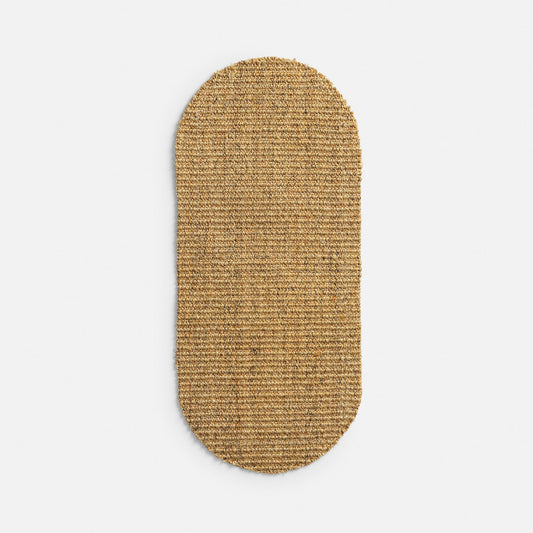
When the mat is worn, replace it with the Line Scratching Mat – Refill, handcrafted from 100% natural sisal.
Browse all of our scratching boards.
When scratching may signal a problem
Scratching is normal. But if your cat suddenly scratches much more than usual, or seems stressed, or has damaged claws, talk to your vet.
Common mistakes
- Punishing the cat. Scratching is instinct, not bad behaviour.
- Choosing a surface that is too short or too light. Your cat cannot stretch, or the board tips.
- Hiding the scratching board. Cats like to scratch where they spend time.
- Keeping a worn-out surface. Replace it when it no longer looks inviting.
- Giving up too early. Cats can take a few days to try something new.
Frequently asked questions
Why do cats scratch?
Scratching is a natural instinct. It helps cats keep their claws in condition, stretch their bodies, mark territory and release energy or stress.
Why do cats scratch the sofa?
A sofa is often sturdy and tall, and it stands where your cat spends time. To stop it, give your cat a better scratching surface next to the sofa.
Do cats scratch to sharpen their claws?
Partly. Scratching helps remove the worn outer layer of the claws, which keeps them in good shape. It also stretches the body and leaves a scent mark.
How do I stop my cat from scratching furniture?
Do not try to stop scratching. Redirect it. Place a stable scratching board next to the furniture, and reward your cat when they use it.
Where should I put a scratching board?
Where your cat already scratches, or near where they sleep. Many cats like to stretch and scratch right after waking up.
In short
- Why: claw care, stretching, marking and release.
- Where: near furniture they scratch and where they sleep.
- What: stable, tall enough and in natural sisal.
- How: redirect, reward and be patient.
At Tail Living, we design scratching boards that respect your cat's instincts and look good in your home.
Explore our scratching boards
-
Line Scratching Board
Regular price 1,300 SEKRegular price -
 Sold out
Line Scratching Mat – Refill
Regular price 300 SEKRegular price

